
The phrase “nice to have” appears in job descriptions, business proposals, emails, presentations, and workplace conversations every day. While it’s a common expression, it can sometimes sound too casual, vague, or repetitive, especially in professional writing.
That’s why many people search for professional synonyms for “nice to have.” Whether you’re writing a resume, preparing a project proposal, creating a job posting, or communicating with clients, choosing stronger alternatives helps you sound more polished and confident.
The good news is that there isn’t just one replacement. The best synonym depends on your audience and the message you want to convey. Some alternatives emphasize preference, while others highlight added value without making something seem essential.
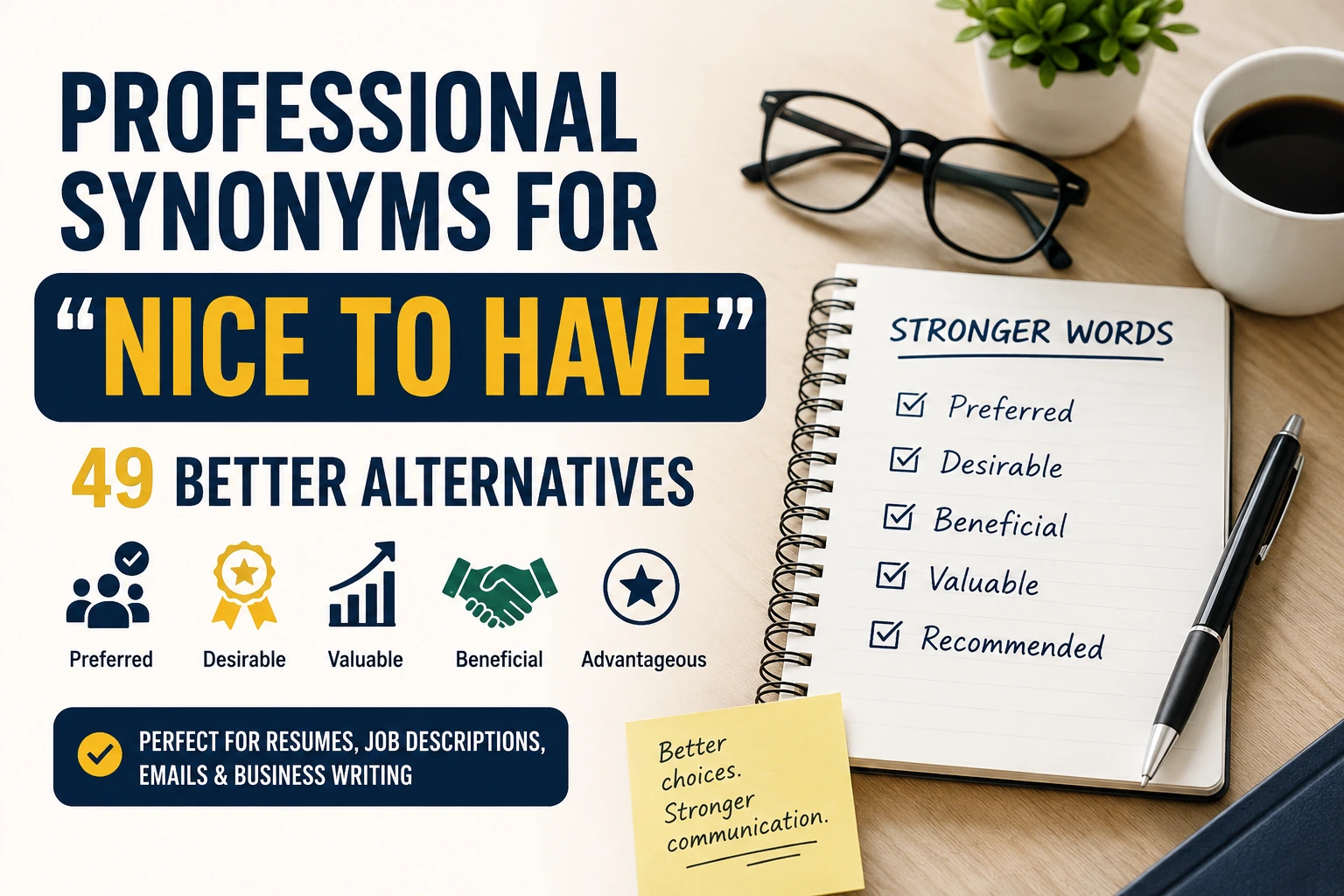
In this guide, you’ll discover 49 professional alternatives to “nice to have,” along with practical examples showing exactly when and how to use each one.
What Does “Nice to Have” Mean?
The phrase “nice to have” refers to something that is beneficial or desirable but not required.
It tells the reader that while a skill, feature, qualification, or resource would improve the situation, success is still possible without it.
For example:
- “Experience with Python is nice to have.”
- “Knowledge of graphic design is nice to have.”
This means those qualifications are appreciated but aren’t mandatory.
You’ll commonly hear this phrase in:
- Job descriptions
- Business meetings
- Client proposals
- Product feature discussions
- Project planning
- Performance reviews
- Professional emails
Replacing it with more precise language often makes your communication sound clearer and more professional.
49 Best Professional Synonyms for “Nice to Have”
Preferred Alternatives
1. Preferred
Example:
“We prefer candidates with project management certification, although it isn’t required.”
2. Desirable
Example:
“Experience with international clients is desirable for this position.”
3. Beneficial
Example:
“Knowledge of data visualization would be beneficial during client reporting.”
4. Advantageous
Example:
“Speaking multiple languages would be advantageous.”
5. Valuable
Example:
“Leadership experience is valuable when managing larger teams.”
6. Helpful
Example:
“Previous startup experience would be helpful.”
7. Favorable
Example:
“Industry certifications are viewed favorably.”
8. Recommended
Example:
“Completion of advanced Excel training is recommended.”
9. Appreciated
Example:
“Previous mentoring experience would be appreciated.”
10. Encouraged
Example:
“Applicants with volunteer leadership experience are encouraged to apply.”
Resume and Job Description Alternatives
11. Preferred Qualification
Example:
“Cloud computing certification is listed as a preferred qualification.”
12. Additional Qualification
Example:
“Fluency in Spanish is considered an additional qualification.”
13. Supplemental Skill
Example:
“Knowledge of SQL is a supplemental skill.”
14. Added Advantage
Example:
“Experience managing remote teams is an added advantage.”
15. Bonus Skill
Example:
“Photography experience is considered a bonus skill.”
16. Plus
Example:
“Experience with Salesforce is a plus.”
17. Extra Benefit
Example:
“Previous consulting experience offers an extra benefit.”
18. Preferred Experience
Example:
“Healthcare industry knowledge is preferred experience.”
19. Optional Expertise
Example:
“Machine learning knowledge is optional expertise.”
20. Supporting Qualification
Example:
“A finance background serves as a supporting qualification.”
Business and Corporate Alternatives
21. Added Value
Example:
“This integration provides added value for enterprise customers.”
22. Optional Enhancement
Example:
“The premium dashboard is an optional enhancement.”
23. Complementary Feature
Example:
“AI-powered reporting is a complementary feature.”
24. Secondary Priority
Example:
“Advanced automation remains a secondary priority.”
25. Future Consideration
Example:
“Voice search optimization is planned for future consideration.”
26. Desirable Addition
Example:
“Live chat support would be a desirable addition.”
27. Supporting Feature
Example:
“Dark mode is a supporting feature.”
28. Value Added Option
Example:
“The analytics dashboard is a value added option.”
29. Enhancement Opportunity
Example:
“This feature represents an enhancement opportunity.”
30. Strategic Advantage
Example:
“CRM integration provides a strategic advantage.”
Professional Email Alternatives
31. If Available
Example:
“Please include supporting documents if available.”
32. Where Appropriate
Example:
“Include case studies where appropriate.”
33. If Applicable
Example:
“Provide certification details if applicable.”
34. Optional
Example:
“Providing references is optional.”
35. As Appropriate
Example:
“Share additional documentation as appropriate.”
36. Additional Consideration
Example:
“This suggestion is offered as an additional consideration.”
37. Worth Considering
Example:
“Hybrid scheduling is worth considering.”
38. Potential Improvement
Example:
“Adding FAQs could be a potential improvement.”
39. Helpful Addition
Example:
“A timeline would be a helpful addition.”
40. Useful Enhancement
Example:
“Interactive charts are a useful enhancement.”
Strong Corporate Alternatives
41. Non Essential
Example:
“The certification is non essential.”
42. Optional Requirement
Example:
“This software knowledge is an optional requirement.”
43. Supplemental Asset
Example:
“Marketing experience is a supplemental asset.”
44. Competitive Advantage
Example:
“Experience with AI tools gives applicants a competitive advantage.”
45. Additional Asset
Example:
“Public speaking skills are an additional asset.”
46. Desired Competency
Example:
“Conflict resolution is a desired competency.”
47. Extra Qualification
Example:
“An MBA is an extra qualification.”
48. Nice Bonus
Example:
“Graphic design skills are a nice bonus.”
49. Preferred but Not Required
Example:
“Professional certification is preferred but not required.”
Real Life Situations
Writing a Job Description
Best choice: Preferred, Desirable, Preferred Qualification
These clearly communicate that applicants without the skill are still welcome.
Updating Your Resume
Best choice: Additional Asset, Competitive Advantage, Desired Competency
These phrases highlight strengths without exaggerating them.
Sending a Professional Email
Best choice: If Applicable, If Available, Where Appropriate
They sound polite, concise, and professional.
Preparing a Business Proposal
Best choice: Added Value, Strategic Advantage, Enhancement Opportunity
These emphasize business benefits rather than optional extras.
Creating Product Documentation
Best choice: Optional Enhancement, Complementary Feature, Supporting Feature
These help customers understand which features are optional.
Common Mistakes to Avoid
1. Using “Nice to Have” Too Frequently
Repeating the same phrase throughout a document makes the writing sound repetitive.
2. Making Optional Items Sound Mandatory
Avoid confusing readers by mixing optional and required qualifications.
3. Choosing Overly Complex Synonyms
Simple professional language is usually more effective than complicated vocabulary.
4. Ignoring Context
Some alternatives work better in resumes, while others fit emails or product documentation.
5. Being Too Vague
Choose words that accurately describe whether something is preferred, optional, or beneficial.
6. Overusing Corporate Buzzwords
Terms like “strategic advantage” should only be used when they genuinely fit the situation.
Pro Tips
Match the audience.
A hiring manager, client, and colleague may all respond better to different wording.
Prioritize clarity over sophistication.
Professional writing should be easy to understand, not unnecessarily complicated.
Use stronger alternatives naturally.
Replace “nice to have” only when another phrase genuinely improves the sentence.
Bonus: Quick One Line Alternatives
- Preferred
- Desirable
- Beneficial
- Advantageous
- Valuable
- Helpful
- Recommended
- Appreciated
- A plus
- Added advantage
Conclusion
While “nice to have” is widely understood, using more precise alternatives can make your writing sound more professional, polished, and persuasive. Whether you’re drafting a job description, updating your resume, preparing a proposal, or writing an email, choosing the right synonym helps communicate your message with greater clarity.
The best replacement depends on the context. Sometimes “preferred” is the strongest choice, while in other situations “beneficial,” “valuable,” or “added advantage” better conveys your meaning. By selecting words that match your audience and purpose, you’ll create communication that is both professional and effective.
Discover more
other ways to say happy to be part of the team