
We’ve all been there. You’re replying to an email, speaking during a meeting, or answering a client’s question, and you instinctively type or say, “To answer your question…” While there’s nothing wrong with the phrase, using it repeatedly can make your communication sound repetitive.
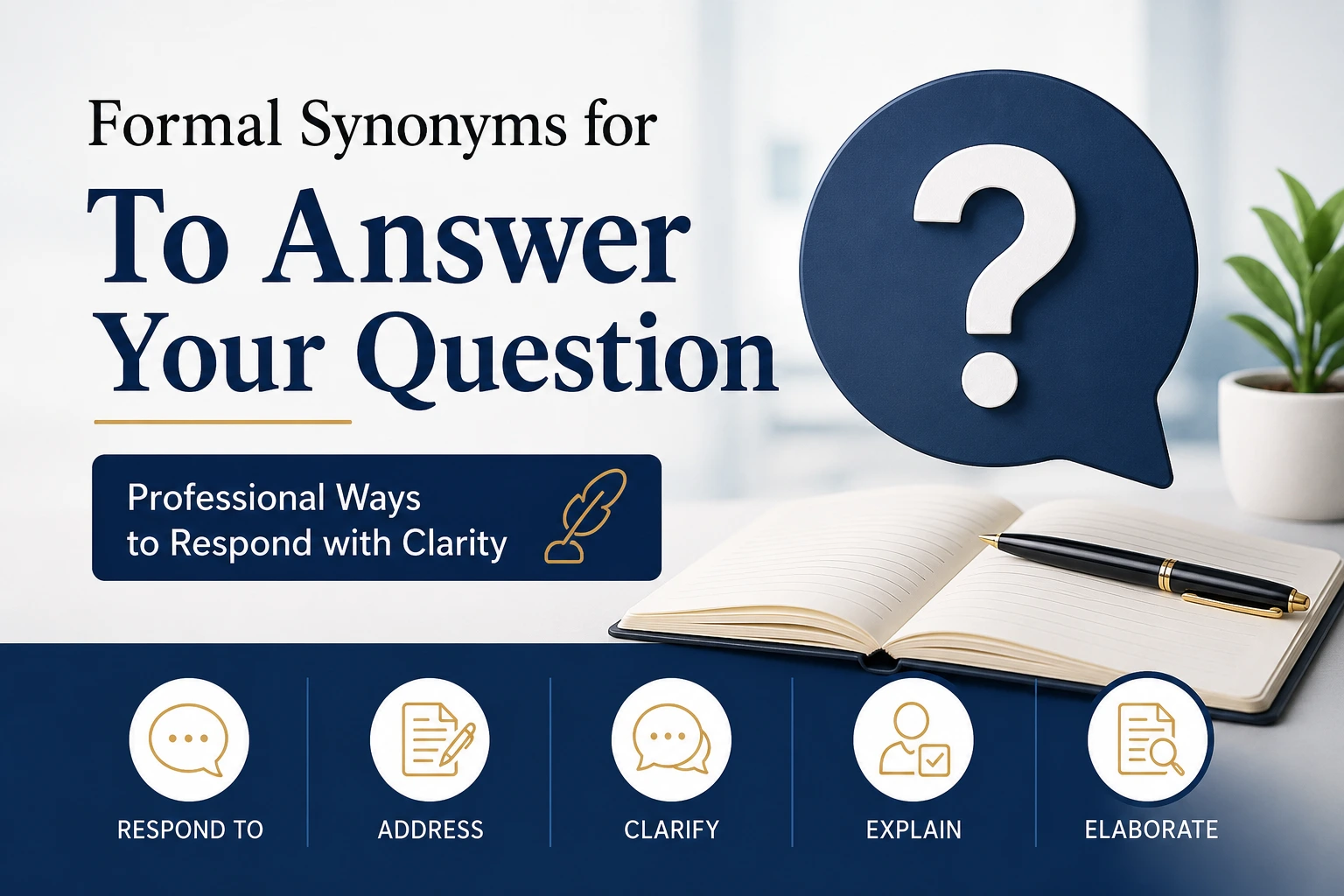
That’s why many professionals look for formal synonyms for “to answer your question.” Whether you’re writing a business email, preparing a presentation, responding in an interview, or communicating with clients, using different expressions can make you sound more polished, confident, and professional.
The best alternative depends on the situation. Some phrases are perfect for formal business writing, while others fit conversations, presentations, or customer support. In this guide, you’ll discover 50 professional alternatives along with practical examples that show exactly when and how to use each one naturally.
What Does “To Answer Your Question” Mean?
The phrase “to answer your question” is commonly used to introduce a direct response after someone asks for information or clarification.
It signals that you’re addressing the specific point someone raised before giving your explanation.
For example:
“To answer your question, yes, the project will be completed this week.”
In professional communication, this phrase helps organize your response and assures the listener that you’re addressing their concern. However, using different expressions can make your writing sound smoother, more engaging, and less repetitive.
50 Best Formal Synonyms for “To Answer Your Question”
Polite and Appreciative
1. In response to your question
Reply: “In response to your question, the report has already been submitted.”
👉 Example: A manager asks about the project status during a meeting, and you begin your reply with this phrase.
2. Regarding your question
Reply: “Regarding your question, the policy remains unchanged.”
👉 Example: A client emails asking about company policies, and you respond professionally.
3. With respect to your inquiry
Reply: “With respect to your inquiry, the requested documents have been attached.”
👉 Example: You reply to a customer’s formal email.
4. Thank you for your question
Reply: “Thank you for your question. Here’s the information you requested.”
👉 Example: A webinar attendee asks something during a live session.
5. I appreciate your question
Reply: “I appreciate your question because it’s an important point.”
👉 Example: You’re speaking during a conference presentation.
6. To address your question
Reply: “To address your question, the software supports multiple users.”
👉 Example: A customer asks about product features.
7. In reply to your question
Reply: “In reply to your question, the deadline has been extended.”
👉 Example: You answer an email from a colleague.
8. As requested
Reply: “As requested, here is the information about our pricing.”
👉 Example: A client asks for additional details before signing a contract.
9. Based on your question
Reply: “Based on your question, I recommend reviewing the updated guidelines.”
👉 Example: A teammate seeks clarification during a meeting.
10. Allow me to clarify
Reply: “Allow me to clarify the process.”
👉 Example: Someone misunderstands a project requirement.
Professional Business Alternatives
11. To clarify
Reply: “To clarify, this feature is included in the premium plan.”
👉 Example: A sales representative explains pricing options.
12. For clarification
Reply: “For clarification, the invoice is due within 30 days.”
👉 Example: You’re responding to an accounting inquiry.
13. The answer is
Reply: “The answer is yes.”
👉 Example: An interviewer asks whether you’re willing to relocate.
14. Specifically
Reply: “Specifically, the update will be released next Monday.”
👉 Example: A client requests an exact timeline.
15. More specifically
Reply: “More specifically, the issue affects older software versions.”
👉 Example: You’re explaining a technical problem.
16. To explain further
Reply: “To explain further, the process consists of three stages.”
👉 Example: You’re training new employees.
17. Let me explain
Reply: “Let me explain how the system works.”
👉 Example: A coworker asks about a workflow.
18. Here’s the explanation
Reply: “Here’s the explanation for the recent changes.”
👉 Example: A team wants to understand a new company policy.
19. The short answer is
Reply: “The short answer is yes.”
👉 Example: Someone asks a straightforward question during a presentation.
20. The detailed answer is
Reply: “The detailed answer requires looking at several factors.”
👉 Example: A client wants an in-depth explanation.
Confident and Professional
21. Certainly
Reply: “Certainly. The contract includes that service.”
👉 Example: You confidently answer a customer’s question.
22. Absolutely
Reply: “Absolutely. We can accommodate that request.”
👉 Example: A client asks whether a customization is possible.
23. Without question
Reply: “Without question, this approach delivers better results.”
👉 Example: You’re discussing best practices with colleagues.
24. Indeed
Reply: “Indeed, the research supports that conclusion.”
👉 Example: You’re presenting findings to stakeholders.
25. I can confirm
Reply: “I can confirm that your application has been approved.”
👉 Example: HR responds to a candidate.
26. I can assure you
Reply: “I can assure you that your information remains confidential.”
👉 Example: A customer has privacy concerns.
27. The correct response is
Reply: “The correct response is outlined in our policy manual.”
👉 Example: You’re answering a compliance question.
28. According to our records
Reply: “According to our records, your payment has been received.”
👉 Example: Customer support checks an account.
29. Based on the available information
Reply: “Based on the available information, approval is likely.”
👉 Example: You’re discussing a project proposal.
30. From our experience
Reply: “From our experience, early planning produces better outcomes.”
👉 Example: A consultant advises a client.
Thoughtful and Mature
31. That’s an excellent question
Reply: “That’s an excellent question. Here’s what we’ve learned.”
👉 Example: A student asks during a seminar.
32. I’m glad you asked
Reply: “I’m glad you asked because it’s often misunderstood.”
👉 Example: A trainer answers a common concern.
33. It’s worth noting
Reply: “It’s worth noting that this policy changes annually.”
👉 Example: You’re providing additional context.
34. One important point is
Reply: “One important point is that deadlines are firm.”
👉 Example: A project manager explains expectations.
35. Here’s what you should know
Reply: “Here’s what you should know before making a decision.”
👉 Example: You’re advising a customer.
36. In simple terms
Reply: “In simple terms, the software automates repetitive tasks.”
👉 Example: You’re explaining a technical concept.
37. Put simply
Reply: “Put simply, the update improves performance.”
👉 Example: You summarize a complex topic.
38. To put it another way
Reply: “To put it another way, the investment reduces long term costs.”
👉 Example: Someone needs a clearer explanation.
39. Looking at it practically
Reply: “Looking at it practically, this option saves both time and money.”
👉 Example: A team debates different solutions.
40. The key point is
Reply: “The key point is that preparation leads to better results.”
👉 Example: You’re concluding a meeting.
Quick Professional Alternatives
41. In brief
Reply: “In brief, the proposal has been approved.”
👉 Example: A manager asks for a quick update.
42. Simply put
Reply: “Simply put, the process is faster now.”
👉 Example: You explain an improvement.
43. To summarize
Reply: “To summarize, we recommend moving forward.”
👉 Example: You conclude a presentation.
44. In short
Reply: “In short, the answer is yes.”
👉 Example: Someone wants a quick response.
45. Briefly
Reply: “Briefly, the issue has already been resolved.”
👉 Example: You’re answering during a busy meeting.
46. For your information
Reply: “For your information, the policy was updated yesterday.”
👉 Example: A colleague requests an update.
47. As follows
Reply: “The details are as follows.”
👉 Example: You introduce a numbered explanation.
48. To elaborate
Reply: “To elaborate, the marketing strategy targets three customer groups.”
👉 Example: A stakeholder asks for more detail.
49. Here’s my response
Reply: “Here’s my response to your concern.”
👉 Example: You reply to a client’s email.
50. My answer is
Reply: “My answer is based on the latest available data.”
👉 Example: You’re participating in a panel discussion.
Real Life Situations
During a Job Interview
Best reply: “Certainly,” or “To clarify.”
Replying to a Client Email
Best reply: “In response to your question,” or “Regarding your question.”
Speaking During a Business Meeting
Best reply: “To address your question,” or “The key point is.”
Responding to Customer Support Requests
Best reply: “I can confirm,” or “With respect to your inquiry.”
Giving a Presentation
Best reply: “That’s an excellent question,” or “To explain further.”
What to Avoid
- Repeating “to answer your question” throughout the same conversation.
- Using overly complicated phrases that sound unnatural.
- Giving long introductions before answering directly.
- Choosing casual expressions in formal business communication.
- Ignoring the tone of your audience.
- Providing vague answers after introducing your response.
Pro Tips
Choose a phrase that matches the formality of the situation. A business email may call for “Regarding your question,” while a presentation might sound better with “That’s an excellent question.”
Answer the question first whenever possible. Readers and listeners appreciate direct, concise responses.
Vary your wording naturally. Rotating between several professional alternatives makes your communication sound polished without feeling repetitive.
Bonus: Quick One Line Alternatives
- Regarding your question
- In response to your question
- To address your question
- To clarify
- Specifically
- I can confirm
- The short answer is
- Here’s the explanation
- In brief
- To summarize
Conclusion
Using formal synonyms for “to answer your question” helps you communicate with greater confidence and professionalism. Whether you’re responding to clients, participating in meetings, writing emails, or answering interview questions, the right phrase can make your message clearer and more engaging.
Instead of relying on the same expression every time, choose an alternative that fits your audience and purpose. Clear communication isn’t just about having the right answer. It’s also about presenting it in the most effective way.
Discover