
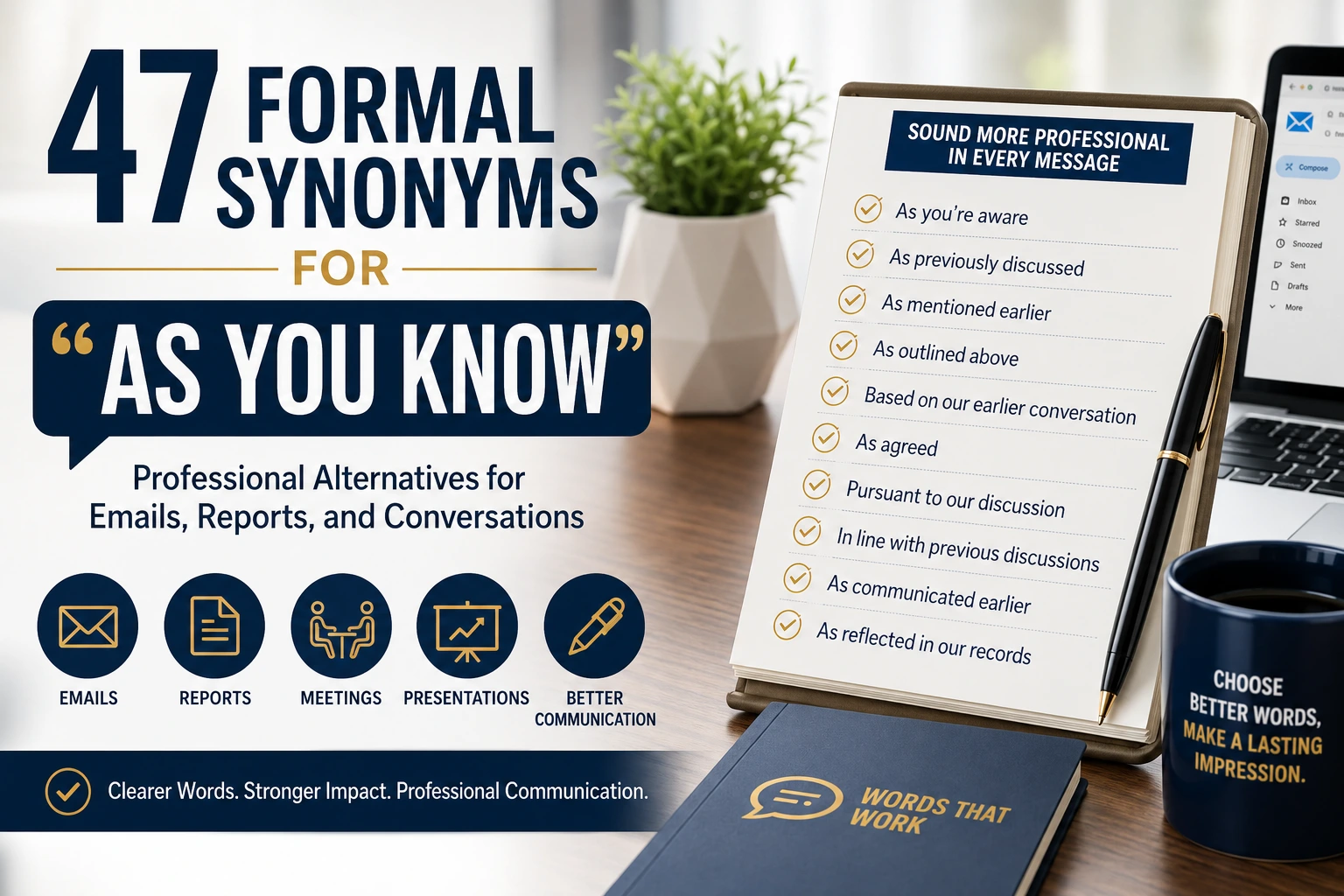
Whether you’re writing a business email, preparing a presentation, drafting a report, or speaking in a professional meeting, you’ve probably used the phrase “as you know” more times than you can count. While it’s a common expression, repeating it too often can make your communication sound repetitive or even slightly presumptuous, especially if you’re reminding someone of information they may not actually know.
That’s why many professionals search for formal synonyms for “as you know.” Choosing a better alternative helps your writing sound polished, respectful, and more engaging. Whether you’re communicating with colleagues, clients, managers, professors, or business partners, using varied expressions can improve clarity and professionalism. In this guide, you’ll discover formal alternatives that fit emails, reports, meetings, and presentations, along with practical examples showing exactly when and how to use each one naturally.
What Does “As You Know” Mean?
The phrase “as you know” is used when referring to information you believe the other person already knows or has previously been told.
People commonly use it to:
- Introduce familiar information.
- Remind someone about an ongoing project.
- Refer to previous conversations.
- Connect new information with existing knowledge.
- Create smoother transitions in presentations and reports.
Although it’s widely accepted in business communication, there are many more professional and polished alternatives that can sound less repetitive and more considerate of your audience.
Polite and Appreciative Alternatives
1. As you’re aware
Example:
During a project update, you say, “As you’re aware, the deadline has been extended by one week.”
2. As previously discussed
Example:
You begin an email by referring to points covered in yesterday’s meeting.
3. As mentioned earlier
Example:
You’re summarizing action items after a conference call.
4. As noted previously
Example:
You reference an earlier report while presenting quarterly results.
5. As outlined in our previous conversation
Example:
You remind a client about the agreed project timeline.
6. As we discussed
Example:
You follow up after a meeting and refer to the agreed next steps.
7. As indicated earlier
Example:
You’re preparing an internal memo and referring to earlier updates.
8. As established
Example:
You explain the project’s objectives during a planning meeting.
9. As confirmed previously
Example:
You remind a supplier about the confirmed delivery schedule.
10. As communicated earlier
Example:
You send a company-wide email regarding an upcoming policy change.
Professional and Formal Alternatives
11. In accordance with our previous discussion
Example:
You write a formal proposal after meeting with a potential client.
12. Based on our earlier conversation
Example:
You summarize agreed deliverables in a follow-up email.
13. Following our previous correspondence
Example:
You continue an ongoing discussion with a business partner.
14. As reflected in our records
Example:
You reference official documentation during an audit.
15. As documented
Example:
You point readers to information contained in a project report.
16. As referenced above
Example:
You guide readers to an earlier section of a written report.
17. In line with previous discussions
Example:
You introduce the next phase of a long-term project.
18. As agreed
Example:
You confirm the final version of a contract before signing.
19. Pursuant to our discussion
Example:
You write a formal legal or corporate email confirming decisions.
Confident and Self Respect Alternatives
20. Considering our earlier agreement
Example:
You remind a client about the approved project schedule.
21. Building on what we’ve already discussed
Example:
You continue a strategy meeting with new recommendations.
22. As acknowledged
Example:
You refer to a previously accepted recommendation during a presentation.
23. In view of our prior discussion
Example:
You explain why certain changes are now being implemented.
24. As previously agreed upon
Example:
You send the finalized proposal and reference the decisions made during your last meeting.
Confident and Self Respect Alternatives
25. As we’ve already established
Example:
You continue a team meeting by referring to the goals everyone agreed on earlier.
26. As we’ve already covered
Example:
You’re moving to the next agenda item after reviewing the project’s objectives.
27. Based on what we’ve discussed
Example:
You send a follow-up email summarizing the action items after a client meeting.
28. Keeping our earlier conversation in mind
Example:
You recommend a solution that aligns with the client’s previously stated priorities.
29. As reflected in our earlier discussions
Example:
You introduce a revised proposal during a stakeholder meeting.
Friendly and Playful Alternatives
These alternatives work well with coworkers, teammates, or people you know well. They are less formal but still respectful.
30. Like we talked about
Example:
You remind your teammate about the presentation slides you discussed yesterday.
31. Remember when we discussed this?
Example:
You continue a casual conversation with a coworker about an upcoming deadline.
32. Going back to our earlier chat
Example:
You send a message to a colleague about completing shared tasks.
33. Picking up where we left off
Example:
You reopen a discussion during your weekly project meeting.
34. Just to build on our last conversation
Example:
You introduce new ideas after a brainstorming session.
35. As we were saying
Example:
You return to a topic after a meeting is briefly interrupted.
36. From our previous conversation
Example:
You email a client with additional details about a service you discussed earlier.
Curious Thoughtful and Mature Alternatives
37. Given our shared understanding
Example:
You explain the next phase of a project after confirming everyone understands the objectives.
38. In light of what we’ve discussed
Example:
You recommend a revised strategy after reviewing recent developments.
39. Considering the information we’ve shared
Example:
You summarize key findings in a project update.
40. As reflected in our conversation
Example:
You prepare meeting notes that capture the agreed decisions.
41. Based on our mutual understanding
Example:
You explain responsibilities before assigning project tasks.
42. As acknowledged during our meeting
Example:
You reference an approved budget during a financial review.
43. As previously communicated
Example:
You remind employees about an upcoming company event.
44. As highlighted earlier
Example:
You refer to important findings while presenting a report.
45. As outlined above
Example:
You guide readers to information already explained in a document.
46. As stated previously
Example:
You summarize the company’s objectives in the conclusion of a report.
47. As reflected in our earlier correspondence
Example:
You reference previous emails while finalizing a business agreement.
Real Life Situations
When Writing a Business Email
Best Alternative:
“As previously discussed”
This sounds professional, polite, and works perfectly for follow-up emails.
When Giving a Presentation
Best Alternative:
“As you’re aware”
It helps transition smoothly without sounding repetitive.
When Writing a Formal Report
Best Alternative:
“As outlined above”
This clearly directs readers to earlier information in the document.
When Speaking in a Team Meeting
Best Alternative:
“Building on what we’ve already discussed”
It creates a natural flow into the next topic.
When Following Up with a Client
Best Alternative:
“Based on our earlier conversation”
This feels warm, professional, and client-friendly.
What to Avoid
Avoid these common mistakes when replacing “as you know”:
- Assuming the reader already knows the information when they may not.
- Repeating the same phrase multiple times in one document.
- Using overly complicated legal language in everyday emails.
- Choosing casual alternatives in formal business communication.
- Sounding patronizing by reminding people of obvious information.
- Forgetting to provide context for new readers or team members.
Pro Tips
Match the Formality to the Situation
Use highly formal alternatives like “Pursuant to our discussion” for legal or executive communication, and choose simpler options like “As we discussed” for everyday workplace emails.
Keep Your Writing Natural
Avoid replacing every instance of “as you know.” Sometimes removing the phrase altogether makes your sentence stronger and more direct.
Consider Your Audience
If you’re writing to someone outside your organization or someone new to the project, briefly restate the relevant information instead of assuming prior knowledge.
Bonus: Quick One Line Alternatives
- As you’re aware
- As previously discussed
- As mentioned earlier
- As agreed
- As communicated earlier
- As outlined above
- Based on our earlier conversation
- In line with previous discussions
- Following our previous correspondence
- As stated previously
Conclusion
Using formal synonyms for “as you know” helps your writing sound more polished, professional, and engaging. Whether you’re preparing a business email, writing a report, delivering a presentation, or communicating with clients, varying your language makes your message clearer and more effective.
Instead of relying on the same phrase repeatedly, choose an alternative that fits your audience and context. Thoughtful word choices demonstrate professionalism, improve readability, and leave a stronger impression. Small changes in wording can make a significant difference in how confidently and effectively you communicate.
Discover more