
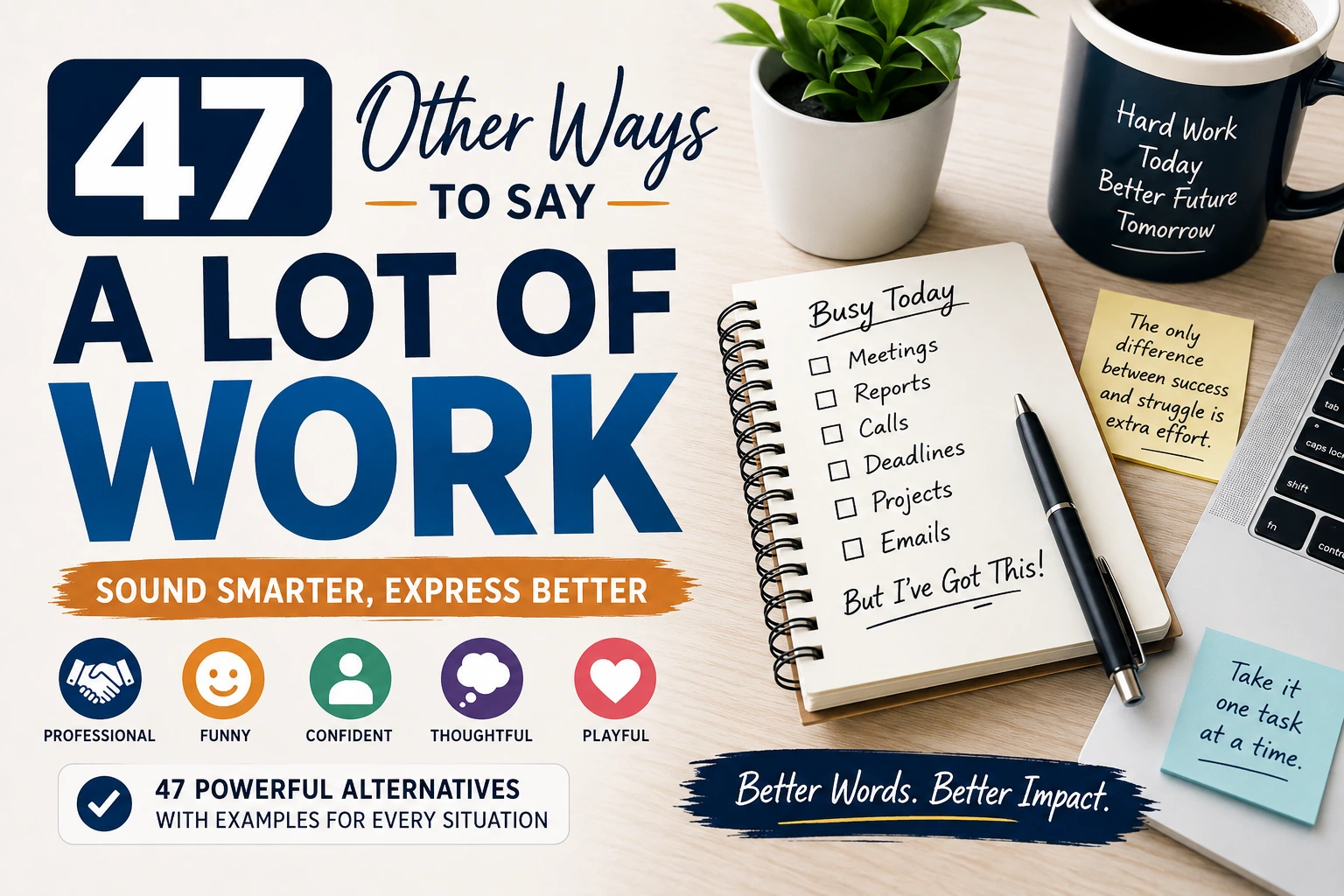
We’ve all had those days when your to do list seems endless, your inbox keeps filling up, and every completed task is replaced with two more. In moments like these, saying something is “a lot of work” gets the point across, but it can also sound repetitive or a little plain. Whether you’re talking to your boss, chatting with coworkers, texting a friend, or writing professionally, having a few better alternatives can make your communication sound more natural and expressive.
That’s why many people look for other ways to say “a lot of work.” The right phrase can help you sound more professional, relatable, or even humorous depending on the situation. In this guide, you’ll discover 47 useful alternatives with real life examples so you’ll always have the perfect expression ready.
What Does “A Lot of Work” Mean?
The phrase “a lot of work” simply means that something requires a significant amount of time, energy, effort, or attention. It can describe a difficult project, a busy schedule, or even a challenging relationship that takes constant effort.
People use this expression in everyday conversations, workplaces, schools, and even casual texts. For example, someone might say, “Planning a wedding is a lot of work,” or “This report is a lot of work, but it’ll be worth it.”
Although it’s a common phrase, using different expressions can make your conversations sound more interesting and better suited to different situations. Some alternatives sound professional, while others are more casual, funny, or thoughtful.
Polite and Appreciative Ways to Say “A Lot of Work”
These alternatives are ideal for professional conversations, emails, meetings, and situations where you want to acknowledge someone’s effort respectfully.
1. Reply: “It requires a great deal of effort.”
Example:
Your manager asks about a new project. You reply, “It requires a great deal of effort, but the team is making excellent progress.”
2. Reply: “It’s quite a demanding task.”
Example:
A coworker wonders why you’ve been busy all week. You explain that preparing the annual report is quite a demanding task.
3. Reply: “There’s a significant amount to handle.”
Example:
Your colleague offers to help. You say, “There’s a significant amount to handle, so I’d really appreciate the extra support.”
4. Reply: “It’s a major undertaking.”
Example:
Someone asks about renovating your house. You smile and say, “It’s definitely a major undertaking, but we’re excited about it.”
5. Reply: “It’s a substantial workload.”
Example:
During a team meeting, you explain that the department is managing a substantial workload this month.
6. Reply: “It takes considerable time and effort.”
Example:
A client asks why the project timeline is several weeks long. You explain that the process takes considerable time and effort to complete properly.
7. Reply: “There’s plenty to get through.”
Example:
Your teammate asks how your day is going. You answer, “There’s plenty to get through, but I’m making steady progress.”
8. Reply: “It’s a fairly involved process.”
Example:
A customer asks why onboarding takes several days. You explain that it’s a fairly involved process because every detail is carefully reviewed.
9. Reply: “It’s no small task.”
Example:
Your professor asks about your research project. You reply, “It’s no small task, but I’m learning a lot along the way.”
10. Reply: “It’s a challenging responsibility.”
Example:
A friend asks how your new leadership role is going. You answer, “It’s a challenging responsibility, but I’m enjoying every opportunity to grow.”
Appreciative Alternatives That Recognize Hard Work
These expressions are perfect when you want to acknowledge someone else’s effort or show appreciation for the amount of work involved.
11. Reply: “You’ve put in an incredible amount of effort.”
Example:
Your teammate stays late to finish an important presentation. You thank them by recognizing how much effort they’ve invested.
12. Reply: “That couldn’t have been easy.”
Example:
Your friend finishes moving into a new house over the weekend. You say, “That couldn’t have been easy. You must be exhausted.”
13. Reply: “You’ve taken on quite a challenge.”
Example:
Someone starts their own business. You admire their determination by saying they’ve taken on quite a challenge.
14. Reply: “There’s clearly a lot of dedication behind this.”
Example:
You compliment a coworker after seeing their completed design project.
15. Reply: “I can tell this took a lot of time.”
Example:
A classmate submits an impressive presentation. You acknowledge the effort they invested.
16. Reply: “You really put your heart into it.”
Example:
Your friend cooks a homemade dinner for everyone. You thank them by recognizing the care behind their work.
17. Reply: “That’s an impressive amount of work.”
Example:
Your colleague finishes organizing months of company records. You praise the accomplishment with this phrase.
18. Reply: “You deserve credit for all the effort.”
Example:
After your teammate successfully completes a difficult assignment, you remind everyone that they deserve recognition.
19. Reply: “I appreciate everything you’ve done.”
Example:
A volunteer spends the entire weekend helping with an event. You sincerely thank them for all their hard work.
20. Reply: “Your hard work really shows.”
Example:
A friend finishes renovating their home. You compliment the final result by pointing out that all their hard work is visible.
Flirty and Playful Ways to Say “A Lot of Work”
These alternatives are perfect for casual conversations, texting, or joking with someone you know well. They keep the mood light while still expressing that something takes a lot of effort.
21. Reply: “You’re definitely keeping me busy.”
Example:
Your crush keeps asking for your help with a project. You smile and say, “You’re definitely keeping me busy, but I don’t mind.”
22. Reply: “Looks like I’ve signed up for quite an adventure.”
Example:
A friend asks if you’re excited about planning a road trip. You laugh and reply, “Looks like I’ve signed up for quite an adventure.”
23. Reply: “This is keeping me on my toes.”
Example:
Someone asks how your new job is going. You answer, “It’s keeping me on my toes every day.”
24. Reply: “It’s a full time challenge.”
Example:
Your friend asks about training for a marathon. You joke, “It’s a full time challenge, but it’s worth it.”
25. Reply: “I’ve got my hands full.”
Example:
You’re taking care of work, family, and school at the same time. A friend checks in, and you reply, “I’ve got my hands full right now.”
26. Reply: “It’s keeping life interesting.”
Example:
Someone notices you’ve been busy lately. You smile and say, “It’s keeping life interesting.”
27. Reply: “I’m earning my coffee today.”
Example:
Your coworker sees you working nonstop. You laugh and say, “I’m earning my coffee today.”
28. Reply: “It’s a workout for my brain.”
Example:
A classmate asks how difficult your assignment is. You answer, “It’s definitely a workout for my brain.”
29. Reply: “I’m juggling more than I expected.”
Example:
You’re balancing several responsibilities at once. You tell a friend, “I’m juggling more than I expected, but I’m managing.”
Confident and Self Respect Ways to Say “A Lot of Work”
These alternatives communicate that you’re handling a heavy workload without sounding overwhelmed. They project confidence and professionalism.
30. Reply: “It’s a challenge I’m prepared for.”
Example:
Your manager asks if the new project is too much. You confidently respond, “It’s a challenge I’m prepared for.”
31. Reply: “It’s demanding, but manageable.”
Example:
A coworker asks how you’re handling multiple deadlines. You answer, “It’s demanding, but manageable.”
32. Reply: “It requires focus and commitment.”
Example:
Someone asks about launching your own business. You explain that success requires focus and commitment.
33. Reply: “I’m handling a heavy workload.”
Example:
A client asks why you’re unavailable this week. You professionally explain that you’re handling a heavy workload.
34. Reply: “It’s keeping me productive.”
Example:
A friend wonders why you’ve been so busy lately. You reply, “It’s keeping me productive, and I’m learning a lot.”
35. Reply: “It’s pushing me to grow.”
Example:
Your mentor asks about your new responsibilities. You answer, “It’s pushing me to grow professionally.”
36. Reply: “I’m investing a lot of effort into it.”
Example:
Someone compliments your recent progress. You explain that you’ve been investing a lot of effort into the project.
37. Reply: “It’s worth every bit of the effort.”
Example:
A friend asks if renovating your home is stressful. You smile and say, “It’s worth every bit of the effort.”
38. Reply: “I’m committed to seeing it through.”
Example:
A teammate asks whether you’ll finish a difficult assignment. You confidently reply, “I’m committed to seeing it through.”
Funny and Savage Ways to Say “A Lot of Work”
These alternatives are great for friends and informal conversations. They add humor while making your point.
39. Reply: “My to do list has its own to do list.”
Example:
A coworker asks how your day is going. You laugh and say, “My to do list has its own to do list.”
40. Reply: “I deserve overtime just for thinking about it.”
Example:
A friend asks how difficult your weekend plans are. You jokingly reply with this line.
41. Reply: “I’m one email away from needing a vacation.”
Example:
Your inbox keeps filling up. You joke with your coworker about how busy the day has become.
42. Reply: “This project aged me three years.”
Example:
After finishing a difficult assignment, you laugh and say this to your teammates.
43. Reply: “I’ve unlocked a new level of busy.”
Example:
Someone asks why you’ve been offline all day. You jokingly explain that you’ve reached a whole new level of busy.
44. Reply: “Even my coffee needs coffee.”
Example:
A friend notices you’re exhausted after work. You use this funny line to describe your day.
45. Reply: “My calendar is filing complaints.”
Example:
Your coworker asks if you’re free next week. You laugh and point to your packed schedule.
46. Reply: “I’m carrying this workload like it’s an Olympic sport.”
Example:
After another long meeting, your teammate asks how you’re doing. You jokingly compare your workload to a competitive event.
47. Reply: “Busy called and asked me to slow down.”
Example:
A friend asks why you’ve been hard to reach. You jokingly respond, “Busy called and asked me to slow down.”
Curious, Thoughtful, and Mature Ways to Say “A Lot of Work”
These alternatives are ideal when you want to sound reflective, understanding, or emotionally intelligent. They work well in meaningful conversations, professional settings, and situations where you want to acknowledge effort without exaggerating.
48. Reply: “There’s more involved than people realize.”
Example:
A friend asks how difficult planning a wedding has been. You reply, “There’s more involved than people realize, but we’re getting there.”
49. Reply: “It’s a process that takes patience.”
Example:
Someone asks how learning a new language is going. You explain that it’s a process that takes patience and consistent practice.
50. Reply: “Good results take real effort.”
Example:
A coworker compliments your successful presentation. You smile and say, “Good results take real effort, but it’s rewarding.”
51. Reply: “Every step adds up.”
Example:
Your friend feels overwhelmed by a renovation project. You remind them that every step adds up over time.
52. Reply: “It’s a journey, not just a task.”
Example:
Someone asks about writing your first book. You explain that it’s a journey, not just a task.
53. Reply: “Success rarely comes without hard work.”
Example:
A student asks how you achieved excellent grades. You answer, “Success rarely comes without hard work.”
54. Reply: “It’s worth taking the time to do it right.”
Example:
Your manager asks why you’re carefully reviewing a report. You explain that it’s worth taking the time to do it right.
Real Life Situations and the Best Reply
When your crush says a project is a lot of work
Situation:
Your crush says, “Planning this event is a lot of work.”
Best reply:
“I can help if you want to make it a little easier.”
This sounds supportive without trying too hard.
When a friend jokes about being busy
Situation:
Your friend says, “My life is nothing but work lately.”
Best reply:
“At least you’ll have some great stories when it’s over.”
It keeps the conversation positive while acknowledging their effort.
When your coworker feels overwhelmed
Situation:
A teammate says they’re buried in work.
Best reply:
“Let’s tackle one thing at a time. We’ll get through it.”
This shows teamwork and encouragement.
When someone complains too early
Situation:
They’ve only just started a project but are already saying it’s impossible.
Best reply:
“Give it a little time. It might be easier once you get into it.”
This offers reassurance without dismissing their feelings.
When you’re not interested in taking on more work
Situation:
Someone asks if you can help with another project.
Best reply:
“I’d love to help, but my schedule is already full.”
It’s honest, polite, and sets a healthy boundary.
What to Avoid
1. Repeating the same phrase every time
Using “a lot of work” in every conversation can become repetitive. Mix in different alternatives to sound more natural.
2. Sounding overly dramatic
Avoid saying everything is “impossible” or “the hardest thing ever.” It can make your message feel exaggerated.
3. Ignoring your audience
Professional settings call for polished language, while casual conversations allow for humor and relaxed expressions.
4. Complaining without offering a solution
If you’re discussing a heavy workload, try mentioning how you’re managing it or what support you need.
5. Using slang in formal communication
Funny expressions are great with friends but may not be appropriate in business emails or meetings.
Pro Tips
Match your words to the situation
Formal conversations deserve professional alternatives, while casual chats leave room for creativity and humor.
Focus on effort instead of stress
Phrases like “It’s a major undertaking” sound more positive than constantly saying you’re overwhelmed.
Keep your tone authentic
The best alternative is one that sounds like something you would naturally say. Authentic communication always feels more genuine.
Conclusion
Finding other ways to say “a lot of work” helps you communicate with more confidence, variety, and personality. Whether you’re describing a challenging project, recognizing someone’s dedication, or simply explaining why you’ve been busy, the right words make your message more engaging.
From professional alternatives to playful and thoughtful expressions, you now have plenty of options for every conversation. Choose the one that best fits your audience and your tone, and you’ll sound more natural without repeating the same phrase over and over.
Discover more
professional ways to say i will do my best