
Have you ever found yourself writing an email, giving a presentation, or participating in a meeting and realized that saying “in my opinion” felt a little too repetitive? You’re not alone. While it’s a perfectly acceptable phrase, using it too often can make your writing or speech sound less polished.
That’s why many people search for formal ways to say “in my opinion.” Whether you’re writing an academic paper, sending a professional email, speaking in a business meeting, or simply trying to sound more confident, choosing the right alternative can make a noticeable difference. A well chosen phrase adds credibility, improves clarity, and helps your ideas sound more thoughtful without coming across as overly forceful.
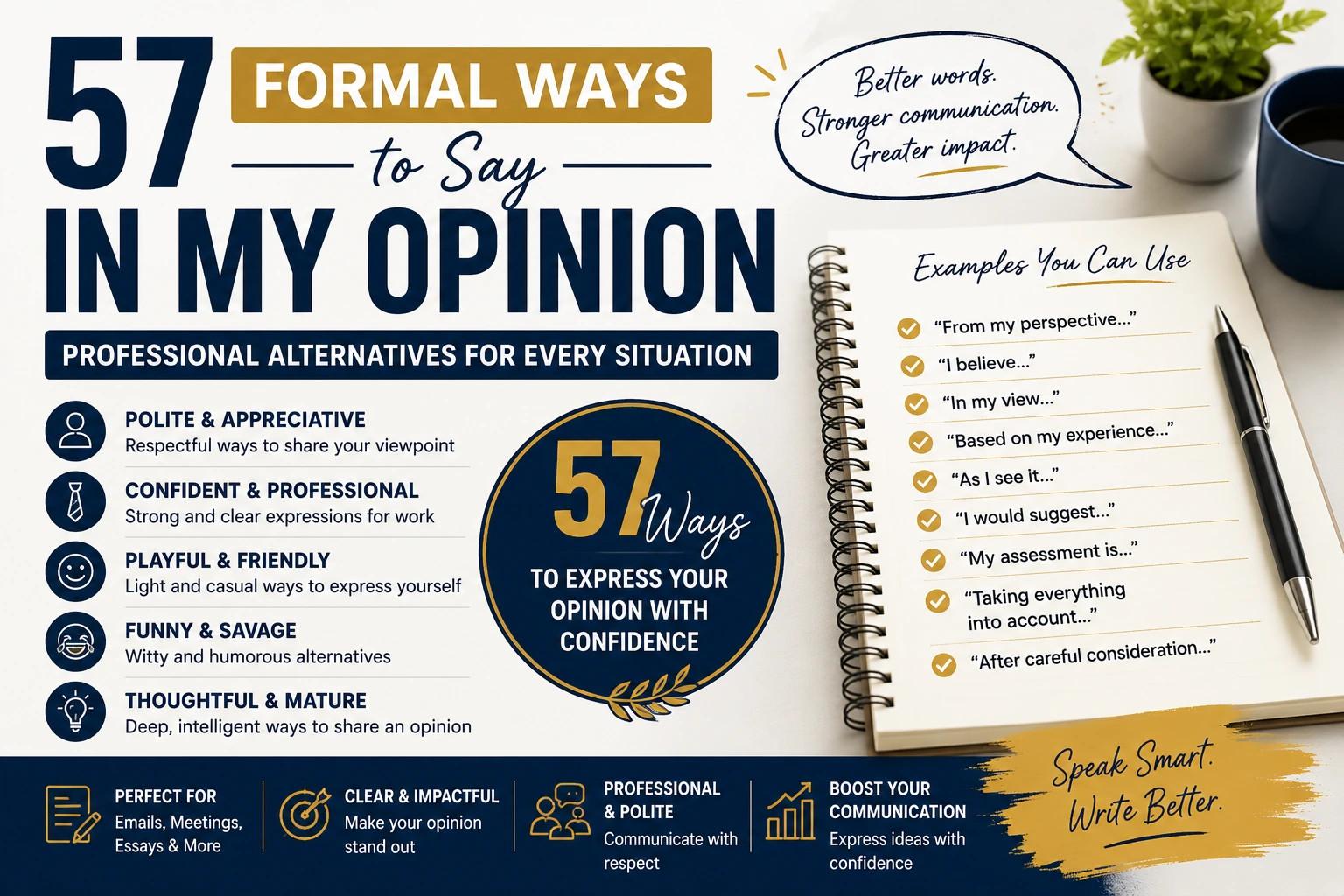
In this guide, you’ll discover 57 professional alternatives to “in my opinion,” complete with real life examples, practical situations, and helpful tips for using each one naturally.
What Does “Formal Ways to Say In My Opinion” Mean?
The phrase “in my opinion” is commonly used to introduce a personal belief, judgment, or viewpoint. It lets others know that what follows is your perspective rather than an absolute fact.
In formal communication, however, there are often better alternatives that sound more polished and professional. These expressions help you present your ideas respectfully while showing confidence and encouraging constructive discussion.
For example, instead of saying, “In my opinion, this strategy will work,” you might say, “From my perspective, this strategy will be effective,” or “I believe this approach offers the strongest solution.”
Using a variety of formal expressions keeps your communication fresh, engaging, and appropriate for different audiences.
57 Formal Ways to Say In My Opinion
Polite and Appreciative Alternatives
1. From My Perspective
Reply: “From my perspective, this approach makes the most sense.”
Example:
During a team meeting, you respectfully present your preferred solution while inviting others to share their views.
2. I Believe
Reply: “I believe this is the most practical option.”
Example:
You explain your recommendation during a project discussion without sounding overly assertive.
3. In My View
Reply: “In my view, customer feedback should guide our decision.”
Example:
A manager asks for everyone’s input, and you offer your perspective professionally.
4. As I See It
Reply: “As I see it, this plan gives us the best chance of success.”
Example:
You contribute to a brainstorming session with confidence and respect.
5. It Seems to Me
Reply: “It seems to me that we’re heading in the right direction.”
Example:
You carefully express your thoughts during a strategy meeting.
6. I Would Suggest
Reply: “I would suggest focusing on quality before speed.”
Example:
A coworker asks for your advice on improving a process.
7. In My Experience
Reply: “In my experience, clear communication prevents most misunderstandings.”
Example:
You share lessons learned from previous projects.
8. Based on My Experience
Reply: “Based on my experience, this method delivers consistent results.”
Example:
You recommend a proven approach during a client presentation.
9. I Would Argue
Reply: “I would argue that preparation is the key to success.”
Example:
You participate in an academic discussion and present your reasoning respectfully.
10. I Personally Believe
Reply: “I personally believe teamwork drives innovation.”
Example:
You share your thoughts during a leadership workshop.
11. To My Mind
Reply: “To my mind, this solution is the most balanced.”
Example:
You contribute to a panel discussion with a thoughtful opinion.
12. In My Judgment
Reply: “In my judgment, the proposal is ready for approval.”
Example:
A supervisor asks for your professional assessment before making a decision.
Flirty and Playful Alternatives
13. If You Ask Me
Reply: “If you ask me, that’s the best choice.”
Example:
Your friend can’t decide which restaurant to visit, and you confidently share your favorite.
14. I’d Say
Reply: “I’d say that’s a pretty smart idea.”
Example:
Your crush asks for your opinion on a movie, and you answer casually.
15. I’d Go With
Reply: “I’d go with the blue one.”
Example:
A friend asks which outfit looks better before a party.
16. My Take Is
Reply: “My take is that honesty always wins.”
Example:
You join a casual discussion about relationships with friends.
17. I’d Lean Toward
Reply: “I’d lean toward the earlier meeting time.”
Example:
Your team is voting on a schedule, and you gently express your preference.
18. If It Were Up to Me
Reply: “If it were up to me, we’d start earlier.”
Example:
Friends are planning a road trip, and everyone shares their preferences.
19. My Feeling Is
Reply: “My feeling is that we’ll enjoy the second option more.”
Example:
You help your friends decide between two vacation destinations.
20. I’d Recommend
Reply: “I’d recommend trying the homemade dessert.”
Example:
A friend asks what to order at your favorite café.
21. My Vote Goes To
Reply: “My vote goes to option B.”
Example:
Your family is choosing a movie for movie night.
22. I Have a Feeling
Reply: “I have a feeling this is the right decision.”
Example:
Your friend is unsure about accepting a new job offer.
23. That’s My Take
Reply: “That’s my take, but I’d love to hear yours.”
Example:
You finish sharing your opinion during a friendly debate.
Confident and Self Respect Alternatives
24. I Am Convinced
Reply: “I am convinced this strategy will succeed.”
Example:
You confidently explain your recommendation during a business presentation.
25. I Strongly Believe
Reply: “I strongly believe communication is the key.”
Example:
A manager asks everyone to share leadership principles.
26. I Maintain That
Reply: “I maintain that consistency produces better results.”
Example:
You defend your viewpoint during a professional discussion.
27. I Stand By the View That
Reply: “I stand by the view that preparation matters most.”
Example:
Someone asks if your opinion has changed after new information.
28. My Assessment Is
Reply: “My assessment is that the risks are manageable.”
Example:
You evaluate a business proposal during a meeting.
29. I Am of the View That
Reply: “I am of the view that flexibility benefits every team.”
Example:
You write a formal report for senior management.
30. I Consider
Reply: “I consider this the most practical solution.”
Example:
You explain your reasoning in an academic discussion.
31. I Hold the Opinion That
Reply: “I hold the opinion that customer service should come first.”
Example:
You participate in a conference panel discussion.
32. I Am Inclined to Think
Reply: “I am inclined to think this option offers the best value.”
Example:
Your colleagues compare two proposals during a meeting.
33. My Position Is
Reply: “My position is that transparency builds trust.”
Example:
You present your official viewpoint during a committee discussion.
34. I See Strong Merit In
Reply: “I see strong merit in this proposal.”
Example:
You provide feedback on a coworker’s presentation.
Funny and Lighthearted Alternatives
35. If My Coffee Gets a Vote
Reply: “If my coffee gets a vote, I’d choose this one.”
Example:
Your coworkers laugh while deciding where to have lunch.
36. My Inner Expert Says
Reply: “My inner expert says this is the answer.”
Example:
Friends ask for your opinion during a trivia game.
37. My Crystal Ball Says
Reply: “My crystal ball says this one wins.”
Example:
You jokingly predict which team will win a friendly competition.
38. According to My Very Scientific Guess
Reply: “According to my very scientific guess, this is the best option.”
Example:
Friends laugh while choosing a vacation destination.
39. My Brain Votes Yes
Reply: “My brain votes yes.”
Example:
You jokingly approve a weekend getaway plan.
40. My Professional Guess
Reply: “My professional guess is this will work.”
Example:
Coworkers joke while estimating project timelines.
41. That’s My Story
Reply: “That’s my story, and I’m sticking to it.”
Example:
Friends debate which pizza place serves the best food.
42. Call It a Hunch
Reply: “Call it a hunch, but I like this option.”
Example:
You predict the outcome of a sports match with friends.
43. If You Want My Two Cents
Reply: “If you want my two cents, I’d choose this one.”
Example:
A family member asks which laptop they should buy.
44. My Vote Is Officially Cast
Reply: “My vote is officially cast.”
Example:
Your office team is selecting a theme for the annual event.
45. I Could Be Wrong, But
Reply: “I could be wrong, but this seems like the right choice.”
Example:
You carefully offer an opinion while keeping the mood light.
Curious, Thoughtful, and Mature Alternatives
46. From Where I Stand
Reply: “From where I stand, this is the fairest solution.”
Example:
You participate in a discussion about workplace policies.
47. Looking at the Evidence
Reply: “Looking at the evidence, this appears to be the strongest option.”
Example:
You analyze data during a project review.
48. Considering the Facts
Reply: “Considering the facts, this decision seems reasonable.”
Example:
Your team reviews research before choosing a strategy.
49. Taking Everything Into Account
Reply: “Taking everything into account, I’d support this proposal.”
Example:
A committee discusses several competing ideas.
50. Upon Reflection
Reply: “Upon reflection, I believe this is the best course of action.”
Example:
You reconsider your initial opinion after hearing everyone else’s views.
51. After Careful Consideration
Reply: “After careful consideration, I support this recommendation.”
Example:
You write a formal response after reviewing multiple reports.
52. I Tend to Think
Reply: “I tend to think this approach offers greater flexibility.”
Example:
You gently express your preference during a planning meeting.
53. It Is My Understanding
Reply: “It is my understanding that this policy will improve efficiency.”
Example:
You summarize your interpretation during a business discussion.
54. My Interpretation Is
Reply: “My interpretation is that both options have merit.”
Example:
You analyze a contract with your colleagues.
55. It Appears to Me
Reply: “It appears to me that we’re making steady progress.”
Example:
You provide an update during a project meeting.
56. I Would Conclude
Reply: “I would conclude that this is our strongest opportunity.”
Example:
You summarize your findings after presenting research.
57. My Conclusion Is
Reply: “My conclusion is that collaboration delivers better outcomes.”
Example:
You wrap up a presentation with a confident final statement.
Real Life Situations
When You’re Writing a Business Email
Best Reply:
“From my perspective, this approach offers the greatest value.”
It sounds professional, respectful, and confident.
When You’re Speaking in a Meeting
Best Reply:
“I believe this solution best addresses our goals.”
This shows confidence while leaving room for discussion.
When You’re Writing an Academic Essay
Best Reply:
“I would argue that this evidence supports the conclusion.”
This is formal and commonly used in academic writing.
When a Friend Asks for Advice
Best Reply:
“If you ask me, I’d choose the simpler option.”
It feels natural without sounding too serious.
When You Want to Sound Diplomatic
Best Reply:
“Taking everything into account, this seems like the strongest option.”
It shows you’ve considered different viewpoints before sharing your own.
Common Mistakes to Avoid
Repeating “In My Opinion” Too Often
Using the same phrase repeatedly makes your writing feel repetitive. Mix in a variety of alternatives.
Sounding Too Certain Without Evidence
Strong statements should be supported by facts, especially in professional or academic writing.
Choosing Informal Phrases in Formal Settings
Expressions like “If you ask me” work well in casual conversations but may not fit formal reports.
Overcomplicating Your Language
Simple, clear wording is often more effective than using overly complex expressions.
Ignoring Your Audience
Choose phrases that match the tone of your conversation, email, presentation, or essay.
Pro Tips
Match the Level of Formality
Business emails, academic papers, and presentations each require slightly different expressions.
Be Confident but Respectful
Present your opinion clearly while remaining open to other perspectives.
Let Your Evidence Speak
The strongest opinions are supported by examples, facts, or logical reasoning.
Conclusion
Using formal alternatives to “in my opinion” makes your communication sound more polished, credible, and engaging. Whether you’re writing an essay, leading a meeting, sending an email, or participating in a discussion, the right phrase helps you express your thoughts with confidence and professionalism.
The best alternative isn’t necessarily the most formal one. It’s the one that fits your audience, your purpose, and your personality. Choose your words carefully, speak with confidence, and let your ideas make the strongest impression.
Discover more
formal synonyms for to answer your question