
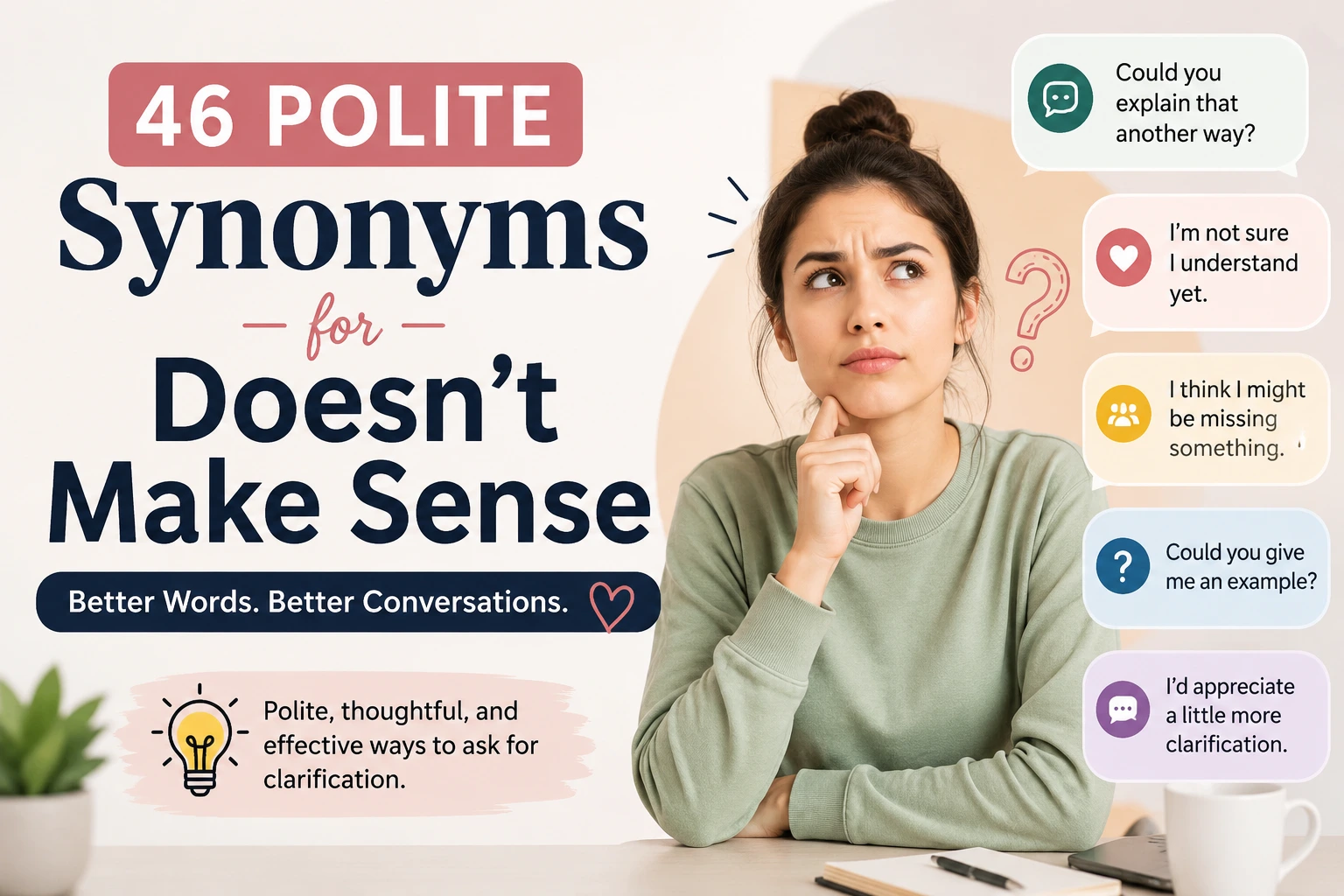
Have you ever been in a conversation where someone explained something, but it just didn’t click? Maybe it happened during a meeting, while texting a friend, or in the middle of a family discussion. Saying “That doesn’t make sense” can sometimes sound blunt, even when you don’t mean to offend anyone. That’s why many people look for polite alternatives that express confusion without hurting the other person’s feelings.
Using respectful language helps you communicate more effectively, avoid misunderstandings, and keep conversations positive. Whether you’re speaking with coworkers, friends, teachers, or clients, choosing the right words shows emotional intelligence and professionalism. In this guide, you’ll discover 46 polite synonyms for “doesn’t make sense,” complete with real life examples, practical situations, common mistakes to avoid, and expert communication tips.
What Does “Polite Synonyms for Doesn’t Make Sense” Mean?
A polite synonym for “doesn’t make sense” is another way of saying that something is unclear, confusing, or difficult to understand without sounding rude or dismissive.
Instead of directly saying, “That doesn’t make sense,” you can choose softer phrases that encourage conversation rather than creating conflict.
People often use these alternatives when:
- Talking to coworkers during meetings.
- Explaining confusion to a teacher or professor.
- Responding respectfully to friends or family.
- Giving feedback to clients or customers.
- Asking someone to explain their point more clearly.
These expressions help maintain respect while making it clear that you need more clarification.
Polite and Appreciative
1. I’m not sure I understand.
Reply: “I’m not sure I understand.”
Example:
Your coworker explains a new process, and you politely ask for more details without sounding critical.
2. Could you explain that a little differently?
Reply: “Could you explain that a little differently?”
Example:
Your teacher gives instructions, but you’re confused, so you ask for another explanation.
3. I think I might be missing something.
Reply: “I think I might be missing something.”
Example:
During a meeting, everyone seems to understand except you, so you take responsibility while asking for clarification.
4. Could you walk me through your thinking?
Reply: “Could you walk me through your thinking?”
Example:
A teammate proposes an idea, and you genuinely want to understand how they reached that conclusion.
5. I’d appreciate a little more clarification.
Reply: “I’d appreciate a little more clarification.”
Example:
A client sends unclear instructions, and you ask politely before starting the project.
6. I’m having trouble following.
Reply: “I’m having trouble following.”
Example:
Your professor moves quickly through a lesson, so you ask them to slow down.
7. Could you give me an example?
Reply: “Could you give me an example?”
Example:
Someone explains a concept, and a practical example would help you understand better.
8. I don’t think I fully understand yet.
Reply: “I don’t think I fully understand yet.”
Example:
A friend explains a complicated story, and you ask them to continue.
9. That part is a little unclear to me.
Reply: “That part is a little unclear to me.”
Example:
While reviewing a report, one section seems confusing.
10. Can you help me connect the pieces?
Reply: “Can you help me connect the pieces?”
Example:
Someone skips several details while explaining an idea.
Flirty and Playful
11. You’re making me think too hard.
Reply: “You’re making me think too hard.”
Example:
Your crush shares a deep joke, and you respond with playful teasing.
12. I need a translator for that.
Reply: “I need a translator for that.”
Example:
Someone uses complicated words while texting.
13. You’re speaking another language.
Reply: “You’re speaking another language.”
Example:
Your partner starts talking about a hobby you know nothing about.
14. Slow down, genius.
Reply: “Slow down, genius.”
Example:
A friend explains something too quickly during a game.
15. You’re losing me a little.
Reply: “You’re losing me a little.”
Example:
Someone tells a long story with too many details.
16. Give me the simple version.
Reply: “Give me the simple version.”
Example:
A friend overexplains a situation.
17. I think my brain needs a minute.
Reply: “I think my brain needs a minute.”
Example:
You’re trying to understand a complicated puzzle.
18. Try that again in plain English.
Reply: “Try that again in plain English.”
Example:
Someone uses technical language while chatting.
Confident and Self Respect
19. I don’t see the connection yet.
Reply: “I don’t see the connection yet.”
Example:
A coworker jumps between unrelated ideas during a presentation.
20. That doesn’t seem consistent to me.
Reply: “That doesn’t seem consistent to me.”
Example:
Someone contradicts themselves during a discussion.
21. I’d like more context.
Reply: “I’d like more context.”
Example:
A manager gives limited information before assigning a task.
22. I need more information before I can agree.
Reply: “I need more information before I can agree.”
Example:
Someone asks you to support an idea immediately.
23. I see it differently.
Reply: “I see it differently.”
Example:
You respectfully disagree during a debate.
24. I’m not convinced yet.
Reply: “I’m not convinced yet.”
Example:
Someone makes a bold claim without evidence.
25. Could you explain your reasoning?
Reply: “Could you explain your reasoning?”
Example:
A teammate suggests changing the project direction.
26. I may need more details.
Reply: “I may need more details.”
Example:
A client leaves important information out.
27. That raises a few questions for me.
Reply: “That raises a few questions for me.”
Example:
You notice gaps in someone’s explanation.
Funny and Savage
28. My brain just filed for overtime.
Reply: “My brain just filed for overtime.”
Example:
A friend explains a complicated conspiracy theory.
29. I think you skipped a few chapters.
Reply: “I think you skipped a few chapters.”
Example:
Someone jumps straight to the ending of a story.
30. You lost me at the second sentence.
Reply: “You lost me at the second sentence.”
Example:
A friend talks too fast.
31. I’m going to need subtitles.
Reply: “I’m going to need subtitles.”
Example:
Someone mumbles while explaining something.
32. My confusion has confusion.
Reply: “My confusion has confusion.”
Example:
A complicated group chat leaves everyone puzzled.
33. That’s above my pay grade.
Reply: “That’s above my pay grade.”
Example:
Someone discusses highly technical topics.
34. I need a flowchart for this.
Reply: “I need a flowchart for this.”
Example:
A coworker explains a complicated process.
35. My calculator just gave up.
Reply: “My calculator just gave up.”
Example:
A friend tries explaining difficult math.
Curious, Thoughtful, or Mature
36. Help me understand your perspective.
Reply: “Help me understand your perspective.”
Example:
You’re discussing different opinions respectfully.
37. What led you to that conclusion?
Reply: “What led you to that conclusion?”
Example:
Someone shares an unexpected opinion.
38. Can we unpack that a bit?
Reply: “Can we unpack that a bit?”
Example:
A discussion becomes more complex.
39. I want to make sure I’m understanding correctly.
Reply: “I want to make sure I’m understanding correctly.”
Example:
Before responding, you verify what the other person meant.
40. Could you clarify that point?
Reply: “Could you clarify that point?”
Example:
A speaker mentions something briefly during a presentation.
41. That’s interesting. Can you explain further?
Reply: “That’s interesting. Can you explain further?”
Example:
Someone introduces a completely new idea.
42. I think there’s something I’m missing.
Reply: “I think there’s something I’m missing.”
Example:
Everyone else seems to understand the discussion.
43. Can you give me more context?
Reply: “Can you give me more context?”
Example:
You receive an unexpected message without background information.
44. I want to understand before I respond.
Reply: “I want to understand before I respond.”
Example:
An online discussion becomes heated.
45. Could we go through that step by step?
Reply: “Could we go through that step by step?”
Example:
Someone explains a difficult process too quickly.
46. I appreciate your explanation, but I’m still a little confused.
Reply: “I appreciate your explanation, but I’m still a little confused.”
Example:
After someone explains twice, you remain respectful while asking again.
Real Life Situations
During a Work Meeting
Best reply:
“I’d appreciate a little more clarification.”
While Texting a Friend
Best reply:
“You’re losing me a little.”
Talking to a Teacher
Best reply:
“I’m not sure I understand.”
During a Healthy Debate
Best reply:
“Help me understand your perspective.”
When Someone Explains Something Too Quickly
Best reply:
“Could we go through that step by step?”
What to Avoid
- Saying “That makes no sense” immediately without asking questions.
- Interrupting someone before they finish explaining.
- Using a sarcastic tone when you’re genuinely confused.
- Assuming the other person is wrong without understanding their point.
- Rolling your eyes or showing frustration instead of asking politely.
- Repeating “I don’t get it” without explaining what is confusing.
Pro Tips
- Match your tone to the situation. Formal conversations usually require more respectful wording.
- Ask follow up questions instead of immediately disagreeing. It keeps conversations productive.
- Stay calm and curious. People are much more willing to explain when they don’t feel judged.
Bonus: Quick One Line Replies
- I’m not following.
- Could you explain that again?
- Can you simplify that?
- I need a little more context.
- That part confused me.
- Could you rephrase it?
- Help me understand.
- Can you give an example?
- I think I missed something.
- Let’s go through it one more time.
Conclusion
The words you choose can make a big difference in how your message is received. Instead of saying “That doesn’t make sense,” try using one of these polite alternatives to express confusion respectfully. Whether you’re talking to a friend, coworker, teacher, or family member, these phrases encourage better communication, reduce misunderstandings, and keep conversations positive. The next time something isn’t clear, choose curiosity over criticism because respectful communication always leads to better conversations
Discover More:
professional ways to say i forwarded the email